
Election integrity has remained a divisive issue within the Republican Party in recent years. Much of the tension stems from the 2020 presidential election, when late-night ballot drops in battleground states appeared to flip results overnight. For Nebraska’s grassroots conservatives, the issue has now turned inward toward the state party, as members of the State Central Committee raise concerns over credentialing and seating of new members.
While many Republican voters remain unaware of the inner workings of the Nebraska GOP (NEGOP), its leadership can wield significant power. In 2022, for example, it was the NEGOP Executive Committee—not voters—that replaced Congressman Jeff Fortenberry with Mike Flood on the ballot after Fortenberry resigned.
Seats Filled, Missing Paperwork
Late last year, a concerted effort was made to fill long-vacant seats in the Douglas County Republican Party (DCRP) from areas that had not been represented in recent years, specifically north and south Omaha.
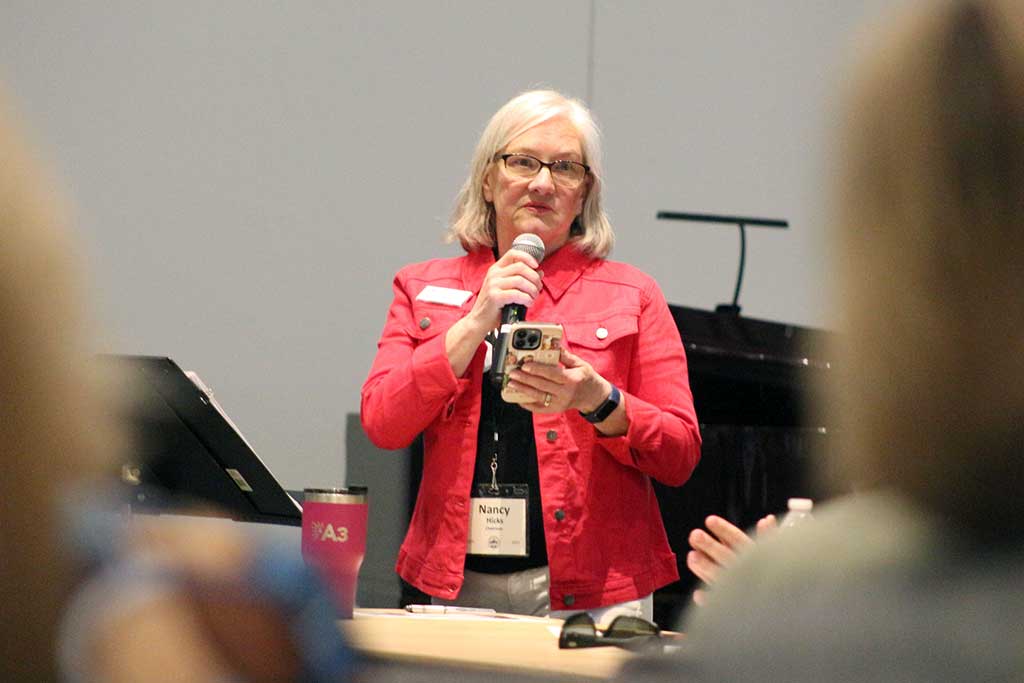
“We were encouraged to try to fill them as best we were able,” DCRP chair Nancy Hicks said. “The DCRP constitution allows us to pull together a caucus from individual legislative districts and allow them to vote for new members for the SCC, which is what we did.”
The timing struck some party members as suspect. The two-year terms of membership were due to reset in 2026, meaning the newly seated members would only have been able to attend one State Central Committee meeting before losing their seats.
“They were filling seats, essentially, for one meeting,” one member said.
According to another committee member, many delegates were seated with little to no documentation of how they were elected.
“All of these new members did not have minutes, caucus information, or dates tied to them, so there was no paper trail to show when these new people were elected and who elected them,” said the committee member. “I went through Douglas County’s minutes and notes. There was nothing. All it said was that members were seated.”
While caucus minutes are not necessarily confidential, Hicks said that no one had previously asked to see them. Cammie Metheny, an executive committee member in District 3, disputes this.
“I asked her if I could see them [the minutes], and she started to get them out of her bag,” Metheny said. “[NEGOP political director] Joe Hagerty interrupted and said, ‘What are you doing?’ And I said, ‘Well, I just wanted to see the minutes from the caucuses where these people got elected into these SCC seats.’ And he said, ‘You have no right to do that.’”
We reached out to Hagerty but received no response.
Substitutions and Forms Being Changed
Additional questions arose regarding substitutes chosen for committee members. Under the party constitution, members may select a substitute if they cannot attend a meeting, such as the one held in Kearney on January 31. That meeting featured a significant number of newly seated members, with as many as 13 out of 18 reportedly sending substitutes.
Who chose the substitutes—and under what circumstances—remains unclear.
Substitutes are requested through an online Google Form. According to Hicks, the committee member must sign the form, and every substitution request included a signature (on an electronic form, this means typing one’s name into a field).
However, problems emerged. Some entries appear to have been tampered with. For example, the Google Form requires an email address, yet a large block of entries in the collected spreadsheet left the email field blank. This suggests the addresses were either scrubbed or the entries were added manually by someone with access to the spreadsheet.
Susie Bliss, chair of the credentialing committee, acknowledged issues with the system. Some members had trouble submitting email addresses that were not Gmail accounts. Bliss also cited possible technical or security problems.
“Possibly we had a glitch in the system,” she said. “We all have the same questions. It’s like, who has access to this form, why is this blank, why does it only accept Gmail emails … I can’t prove this, but somebody got in there and made some changes, because like I said, I have no idea who had access to it.”
Bliss said that the party has since added a phone verification step for each committee member to confirm their substitute and will stop using Google Forms in the future.
Questions Over Substitutes Being Named
Concerns also surfaced regarding specific entries in the block of names missing email addresses.
One woman who uses a wheelchair and could not travel to Kearney selected her own substitute—Caleb Salvatore of Ralston—only to learn later that someone else had been chosen for her.
Another member was unaware a substitute had been selected and traveled to Kearney expecting to be seated. She only learned of the substitution upon arrival, leading to a situation in which she was called before the caucus to “clear the air,” as Bliss described.
A third case involved a woman, who reportedly had trouble using Anedot, the NEGOP’s official payment system, to pay the required meeting fee. Bliss allowed her to pay a discounted rate after the deadline by Venmo.
“Yes, I did try and attempt to get a check from her numerous times, and it didn’t work out,” Bliss said. “And finally, I said, I’m going to Lincoln. I need your $50. And she’s like, ‘Well, how about if I just Venmo you?’ And I’m like, ‘Okay, just Venmo me then.’ And I went and I cashed it.”
While Bliss described her actions as an attempt to help, others viewed it as preferential treatment aimed at securing votes sympathetic to party leadership.
Substituting for Whom?
Confusion persisted at the January meeting. Denise Bradshaw, who was working at the credentialing desk, reported that some substitutes arrived without knowing whom they were replacing.
“Why would you not know? That doesn’t even make sense,” one executive committee member said. “You should have gotten the paperwork on it—or maybe you have the signed sheet right in your hand.”
Bliss, however, said this is not unusual.
“We had an SCC meeting in Gering, and I was there to sign in, and they needed a substitute for some CD district, and I couldn’t tell you who I was even substituting for,” she said.
Metheny, who previously served on the credentialing committee, called that explanation outside the norm.
“There was never any question on who was a sub, who they were subbing for, how the form was submitted, whether it was a paper form or an electronic form,” she said. “It was very black and white. You either had a form you signed and it was on the Google Drive, or you filled it out electronically, and there was no information missing.”
Chair Hicks acknowledged the problem.
“There have been a lot of issues with it. And I think obviously every sub should know who they’re subbing for. But obviously some of them just wanted to make sure they had a sub and didn’t particularly care who it was,” Hicks said.
The intense scrutiny over seating new members and their substitutes coincided with the election for an important party position: the member-at-large role in CD2, left vacant by the resignation of Jacob Wolff last year.
Denise Bradshaw had worked to secure votes, but she lost to Dave Brodahl by a vote of 18–32—a result many attributed to substitutes filling in for newly seated members.
Spillover into the Secretary of State Race
Election integrity is a central issue in the race for Secretary of State between Bob Evnen and Scott Petersen. Petersen serves as Vice Chair for CD2 and an executive committee member of the NEGOP. Grassroots members have specifically criticized him over the controversy.
“Scott Petersen was made aware, BEFORE the SCC meeting, and did NOTHING—rather he ignored it and during the meeting snapped at SCC members for daring to question the obvious fraud,” Allie Bush of Nebraskans Against Government Overreach stated. “Having known the previous credentialing chairs and attended ALL SCC meetings the last 4+ years, the method by which substitutions took place has NEVER occurred before… What occurred at the SCC meeting in January was a rigged election. 32–18 votes. Had they removed the 15 fraudulent subs, the election in CD2 would have gone the other way.”
Petersen is currently advocating for hand-counted paper ballots as a matter of election integrity. Critics note the irony that this process was not followed for party substitutions. The substitute form was electronic, and even paper forms appear to have been manually added to the spreadsheet.
The controversy echoes battles in Sarpy County in 2023, when grassroots challengers—including current Sarpy GOP Chair Michael Tiedeman and NEGOP Political Director Joe Hagerty—ousted then-Chair Nora Sandine over similar membership and credentialing disputes. Some activists now see history repeating itself.
Two reports from committee members detailing these issues have been submitted and distributed, one making an explicit call for transparency.
“We are the party of election integrity, transparency, and law and order—that is the promise we make to voters and the public,” the report stated. “If we demand integrity from others, we must first demand it from our own leaders.”